


Welcome to AP Exam! If you’re working toward a higher AP U.S. History score, you’re in the right place.
Preparing for APUSH can feel overwhelming at first. There are historical periods to understand, important developments to remember, primary sources to analyze, and several different question types to master. The good news is that improving your AP US History Score isn’t about memorizing every single fact in your textbook. It’s about learning how to use historical knowledge effectively when you’re answering AP-style questions.
This guide has been prepared from an AP exam and educational-content perspective, with a strong focus on the skills students actually need when working through AP-style questions, practice tests, historical evidence, and score-improvement strategies. Our approach combines careful attention to AP exam requirements with practical study techniques designed to help students understand why they are missing questions and what they can do differently next time.
Rather than giving you a list of generic study tips, we’ll walk through the areas that can have the biggest impact on your APUSH performance, including multiple-choice questions, SAQs, DBQs, LEQs, historical reasoning, time management, and targeted practice.
You’ll also learn how to use an AP US History Score Calculator to turn your practice results into a useful progress indicator, so you can see whether your preparation is actually moving in the right direction.
Whether you’re aiming to move from a 2 to a 3, a 3 to a 4, or pushing from a 4 toward a 5, let’s get started.
Table of Contents
What Does AP US History Actually Test?
AP U.S. History, commonly known as APUSH, covers American history from 1491 to the present. But the exam isn’t simply a test of whether you can remember names, dates, battles, presidents, and historical events.
APUSH asks you to understand historical developments and use evidence to explain them. You’ll need to analyze primary and secondary sources, identify historical context, recognize patterns, compare developments, and build arguments supported by evidence.
Some of the major skills involved include:
- Analyzing primary and secondary sources
- Understanding historical context
- Identifying cause and effect
- Recognizing continuity and change over time
- Comparing historical developments
- Evaluating claims and evidence
- Developing a defensible thesis
- Supporting arguments with specific historical evidence
- Explaining how evidence supports an argument
This distinction is extremely important when you’re trying to improve your AP US History Score.
You can memorize hundreds of facts and still struggle if you don’t know how to apply those facts to an unfamiliar document or question.
For example, don’t simply memorize that the Missouri Compromise occurred in 1820.
Ask yourself:
- What problem was the compromise trying to address?
- Why had sectional tensions increased?
- What did the compromise accomplish?
- What problem did it leave unresolved?
- How did the issue of slavery continue to affect American politics?
That type of thinking is much closer to what you’ll need on the APUSH Exam.
If you’re new to Advanced Placement exams generally, our guide to understanding AP Exams can give you useful background before you focus specifically on APUSH.
Understand the AP US History Exam Before You Study
One of the easiest ways to waste study time is to prepare without understanding the structure of the exam.
The AP U.S. History Exam combines multiple-choice questions with short-answer questions and two different types of longer written responses. The current exam includes a multiple-choice section, three short-answer questions, a document-based question, and a long essay question.
APUSH Exam Structure
| Section | Questions | Recommended Time | Weight |
|---|---|---|---|
| Multiple Choice | 55 | 55 minutes | 40% |
| Short Answer | 3 | 40 minutes | 20% |
| Document-Based Question | 1 | 60 minutes | 25% |
| Long Essay Question | 1 | 40 minutes | 15% |
| Total | — | 3 hours 15 minutes | 100% |
The multiple-choice section uses groups of questions based on different stimuli, including primary and secondary texts, images, maps, and other historical material.
The short-answer section requires students to respond to historical prompts and demonstrate their ability to use evidence and historical reasoning.
The DBQ asks you to develop an argument using historical documents and additional knowledge, while the LEQ requires you to construct an argument around a historical question.
This structure should directly influence your study plan.
If you spend nearly all of your preparation time memorizing facts and answering multiple-choice questions but rarely practice writing, you’re leaving a major part of the exam untouched.
Find Out Why Your AP US History Score Is Low
Before changing your entire study routine, figure out what’s actually causing your weak performance.
A low practice score doesn’t automatically mean that you need to reread the entire APUSH textbook.
You might have a content problem.
Or you may know the content but struggle to apply it to an unfamiliar source.
Perhaps you understand the historical information but don’t answer the prompt directly enough in your written responses.
Or maybe your knowledge is strong but your timing causes you to rush through the final section.
Try to identify which category best describes you:
- Content weakness: You don’t know enough about particular historical periods or developments.
- Chronology weakness: You know individual events but struggle to place them in the correct historical sequence.
- Source-analysis weakness: You have difficulty interpreting documents, images, maps, or charts.
- Question-reading weakness: You misunderstand what a question is asking.
- Writing weakness: Your evidence is relevant, but your argument or explanation isn’t developed enough.
- Timing weakness: You know the material but don’t finish comfortably.
- Consistency weakness: Your performance changes significantly from one practice test to another.
This diagnosis matters because the solution depends on the problem.
If you have a content gap, study the relevant history.
If you know the content but consistently miss stimulus-based questions, spend more time on source analysis.
If your essays contain good evidence but weak explanation, your next study session should focus on commentary rather than another chapter of notes.
Build a Strong APUSH Timeline
APUSH becomes much easier when you stop viewing American history as thousands of unrelated facts.
Think of American history as a connected story.
The course is organized into nine units covering periods from 1491–1607 through 1980–Present. The College Board assigns different approximate percentages of the exam to each unit, with Units 3 through 8 representing some of the larger portions of the course.
APUSH Units at a Glance
| Unit | Historical Period | Approximate Exam Weight |
|---|---|---|
| Unit 1 | 1491–1607 | 4%–6% |
| Unit 2 | 1607–1754 | 6%–8% |
| Unit 3 | 1754–1800 | 10%–17% |
| Unit 4 | 1800–1848 | 10%–17% |
| Unit 5 | 1844–1877 | 10%–17% |
| Unit 6 | 1865–1898 | 10%–17% |
| Unit 7 | 1890–1945 | 10%–17% |
| Unit 8 | 1945–1980 | 10%–17% |
| Unit 9 | 1980–Present | 4%–6% |
These percentages don’t mean that you should ignore Units 1, 2, or 9.
Instead, use the course structure to organize your preparation.
Create a timeline where major events are connected through:
Cause → Development → Consequence
For example:
Great Depression → economic crisis → New Deal programs → expanded federal role
Another example:
World War II → greater U.S. global involvement → Cold War → containment and international alliances
Once you start thinking this way, individual facts become easier to remember because they have a place within a larger historical story.
Focus on Cause, Effect, Continuity, and Change
One of the most effective ways to improve your AP US History Score is to stop asking only:
What happened?
Instead, ask:
Why did it happen, what changed because of it, and what remained the same?
These four concepts are useful throughout APUSH:
Cause
What factors contributed to a historical event or development?
Effect
What happened as a result?
Continuity
What remained relatively consistent over time?
Change
What became different?
For example, when studying westward expansion, don’t memorize each event separately.
Connect developments such as:
- Manifest Destiny
- Territorial expansion
- Native American displacement
- Mexican-American War
- Expansion of slavery
- Sectional conflict
- Civil War
Now you’re studying a historical process rather than a list of vocabulary terms.
This kind of thinking also makes it easier to answer questions that ask you to connect one historical period to another.
Don’t Try to Memorize Every Date
Dates are useful, but memorizing hundreds of exact dates shouldn’t become your entire APUSH strategy.
You should understand the general chronology of major developments, but spend more time learning their historical significance.
Important developments to understand include:
- American Revolution
- Constitution
- Early political parties
- Market Revolution
- Reform movements
- Manifest Destiny
- Expansion of slavery
- Civil War
- Reconstruction
- Industrialization
- Progressive Era
- World War I
- Great Depression
- New Deal
- World War II
- Cold War
- Civil Rights Movement
- Vietnam War
- Conservative movement
For each major development, ask:
- What happened?
- Why did it happen?
- Who was affected?
- What changed afterward?
- What stayed the same?
- How did it connect to another historical development?
This gives you knowledge that can actually be used in multiple-choice questions and written responses.
Improve Your APUSH Multiple-Choice Performance
APUSH multiple-choice questions aren’t simply historical trivia questions.
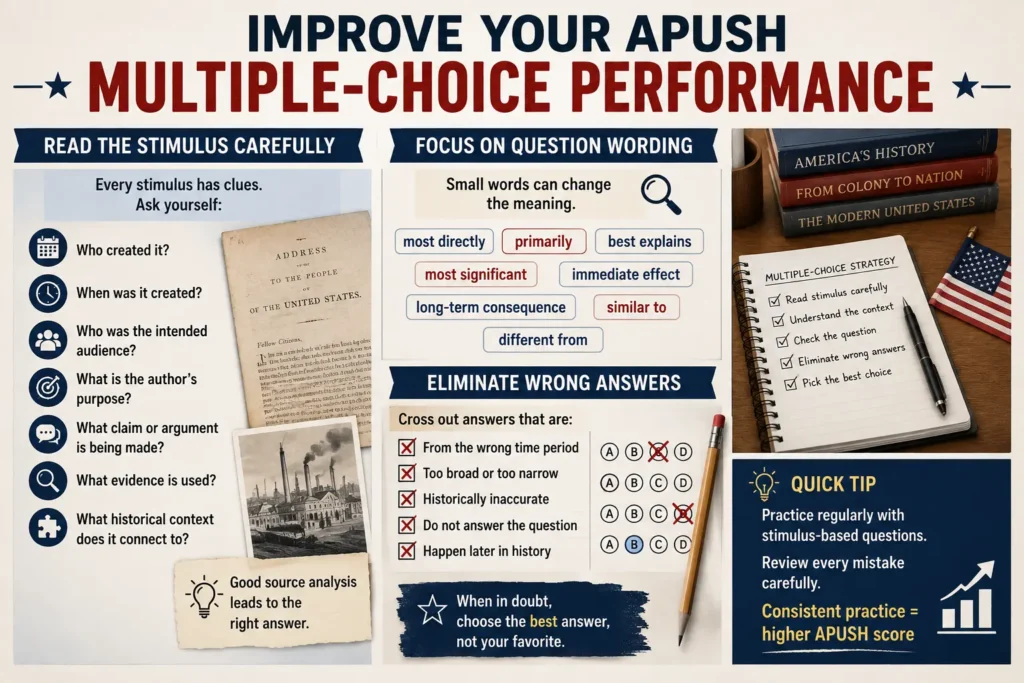
Many are built around a stimulus, meaning you’ll need to understand both the historical material and the source itself.
The College Board describes the multiple-choice section as containing groups of questions based on stimuli such as primary and secondary texts, images, charts, and maps.
That means you need two abilities working together:
Historical knowledge + source analysis
When you encounter a stimulus, consider:
- Who created it?
- When was it created?
- What was happening historically at that time?
- Who was the intended audience?
- What was the author’s purpose?
- What argument or claim is being made?
- What evidence supports that claim?
- What larger historical development does it connect to?
You don’t necessarily need to write down answers to all of these questions.
The goal is to train yourself to recognize the important information quickly.
Pay Attention to Question Wording
Small words can completely change what a question is asking.
Watch for phrases such as:
- “most directly”
- “primarily”
- “best explains”
- “most significant”
- “immediate effect”
- “long-term consequence”
- “similar to”
- “different from”
Don’t answer the question you expected to see.
Answer the question that’s actually there.
Learn How to Eliminate Wrong Answers
You don’t always need to immediately know the correct answer.
Sometimes the fastest strategy is to identify why the other choices are wrong.
An answer choice might be:
- From the wrong historical period
- Related to the topic but not the question
- Historically inaccurate
- Too broad
- Too narrow
- A real event that happened later
- A real development that doesn’t explain the stimulus
If you can confidently eliminate two choices, you’ve already improved your chances.
When you’re unsure, use the evidence in the stimulus and your knowledge of historical context to make the strongest choice possible.
Master the SAQ Before Moving to the DBQ
Short-answer questions are easy to underestimate.
Because SAQs are shorter than essays, students sometimes assume they require little preparation.
But the current APUSH exam includes three SAQs in 40 minutes, and the questions can require different forms of historical reasoning.
The key is to answer exactly what the prompt asks.
If an SAQ contains parts A, B, and C, treat them as three separate opportunities to demonstrate what you know.
SAQ Checklist
Before moving on, ask yourself:
- Did I answer every part?
- Did I provide a specific historical example?
- Did I explain the example?
- Did I connect it directly to the question?
- Did I avoid unnecessary information?
Don’t spend half your time writing a long introduction.
SAQs reward direct, relevant responses.
Get Better at the APUSH DBQ
The Document-Based Question is one of the biggest opportunities to improve your AP US History Score because it combines content knowledge, source analysis, and historical reasoning.
The DBQ includes seven documents and asks students to develop and support an argument using those documents along with additional historical evidence.
The biggest mistake is treating the DBQ as a document-summary exercise.
It isn’t.
You’re building an argument.
A Strong DBQ Process
1. Read the prompt carefully
Identify:
- The time period
- The historical issue
- The task
- What the question actually asks you to evaluate or explain
2. Read the documents strategically
Don’t simply summarize each document.
Ask yourself what each document contributes to your potential argument.
3. Group the documents
Look for relationships.
Documents may share:
- Political perspectives
- Economic interests
- Social concerns
- Religious beliefs
- Regional differences
- Arguments about government power
- Reactions to historical developments
4. Develop a defensible thesis
Your thesis should answer the actual question rather than simply restating it.
5. Use evidence
Bring relevant documents into your argument.
6. Add outside historical evidence
Use relevant knowledge beyond the documents when appropriate.
7. Explain the evidence
Don’t simply tell the reader what a document says.
Explain how it supports your argument.
Use Historical Evidence More Effectively
Knowing a lot of history doesn’t automatically mean you’ll earn all the available evidence-related points.
Your evidence needs to be relevant to the argument you’re making.
Imagine you’re writing about the causes of sectional conflict before the Civil War.
You might know about:
- Missouri Compromise
- Compromise of 1850
- Kansas-Nebraska Act
- Dred Scott decision
- Bleeding Kansas
- Lincoln-Douglas debates
Simply listing those events doesn’t create an argument.
You need to explain how they demonstrate the development or intensification of sectional conflict.
A useful pattern is:
Historical fact → explanation → connection to argument
For example:
Kansas-Nebraska Act → popular sovereignty → renewed conflict over the expansion of slavery → increased sectional tension
That’s far more useful than simply writing that the Kansas-Nebraska Act happened in 1854.
Improve Your LEQ Strategy
The Long Essay Question gives you a choice of prompts and asks you to develop and support a historical argument using evidence.
The LEQ represents 15% of the total APUSH exam score and is allocated 40 minutes.
You don’t need to write an enormous essay.
You need to write a focused argument.
Before you begin, quickly identify:
- What is the prompt asking?
- What time period does it cover?
- What position can I defend?
- What evidence do I know?
- How can I organize that evidence?
A short mental outline can prevent your essay from becoming a collection of unrelated facts.
A useful structure is:
Thesis → Evidence → Explanation → Evidence → Explanation → Complexity or Connection
The exact structure can vary, but the central principle remains the same:
Your evidence should serve your argument.
Stop Studying APUSH Like a Vocabulary List
One of the biggest improvements you can make is changing the way you take notes.
Instead of writing:
Andrew Jackson — President — Indian Removal — Bank War — 1829–1837
try organizing the information around a larger historical idea.
Jacksonian Democracy
- Expanded political participation for many white men
- Increased use of presidential power
- Conflict over the national bank
- Indian Removal policy
- Continued debates over federal authority
Now the information has context.
You can also create comparison charts to identify long-term historical patterns.
| Historical Theme | Earlier Development | Later Development | Historical Connection |
|---|---|---|---|
| Federal Power | Articles of Confederation | Constitution | Stronger national government |
| Expansion | Louisiana Purchase | Manifest Destiny | Continued territorial growth |
| Slavery | Colonial labor systems | Sectional conflict | Slavery became central to political conflict |
| Reform | Second Great Awakening | Progressive Era | Reform movements continued across periods |
| Civil Rights | Reconstruction Amendments | Civil Rights Movement | Long-term struggle over equality |
This type of comparison practice can help you recognize patterns when an exam question presents unfamiliar historical material.
Create a Study Plan Instead of Cramming
APUSH contains too much material for last-minute memorization to be your only strategy.
A structured plan is more useful.
A practical weekly routine could include:
Monday: Content Review
Study one historical period, theme, or major development.
Tuesday: Multiple Choice
Complete a set of APUSH-style multiple-choice questions.
Wednesday: Mistake Review
Go back through incorrect answers and identify the reason for each mistake.
Thursday: Writing Practice
Work on SAQs, a DBQ section, or an LEQ.
Friday: Connections
Review timelines, cause-and-effect relationships, comparisons, and major themes.
Weekend: Timed Practice
Complete a longer timed practice session and record your results.
Save My Exams recommends using the APUSH course structure to organize revision, setting study goals, and focusing additional effort on weaker areas.
The exact schedule isn’t as important as consistency.
Use Active Recall Instead of Just Rereading
Rereading your textbook can create the feeling that you know the material because everything looks familiar.
That doesn’t necessarily mean you’ll be able to recall it under exam conditions.
Instead, close your notes and ask:
What do I remember?
Try using:
- Flashcards
- Practice questions
- Blank timelines
- Concept maps
- Self-quizzing
- Teaching a topic to someone else
- Writing short explanations from memory
For example, close your notes and explain:
Why did the Progressive movement develop?
If you can’t explain it without looking at your notes, you’ve identified an area that needs more attention.
Use the AP US History Score Calculator to Track Progress
Once you’ve completed practice tests, don’t just write down your result and forget about it.
Use an AP US History Score Calculator to turn your practice performance into an estimated AP score and track how your performance changes over time.
You can use our AP US History Score Calculator after a practice session to get an estimate based on your results.
The most useful approach is to maintain a simple progress record.
| Practice Test | Main Weakness | Main Strength | Estimated AP US History Score |
|---|---|---|---|
| Practice 1 | SAQs | Multiple Choice | Your Result |
| Practice 2 | DBQ | SAQs | Your Result |
| Practice 3 | Timing | DBQ | Your Result |
| Practice 4 | Weak Unit | LEQ | Your Result |
The exact number matters less than the trend.
If your estimated score gradually improves, your preparation is moving in the right direction.
If it doesn’t change, don’t simply take another practice test.
Find out why.
What to Do If Your AP US History Score Is Stuck
Sometimes students study consistently but their practice scores stop improving.
That can be frustrating, but a plateau often means you need to change your practice method.
If You Keep Missing Multiple-Choice Questions
Focus on:
- Stimulus analysis
- Question wording
- Historical context
- Chronology
- Cause and effect
- Comparing developments
If You Struggle With SAQs
Practice answering each part directly and completely.
If Your DBQ Is Weak
Work specifically on:
- Thesis
- Document use
- Historical context
- Outside evidence
- Connecting evidence to your argument
If Your LEQ Is Weak
Practice developing a clear argument from a smaller number of strong historical examples.
If Timing Is the Problem
Complete timed sections rather than always studying without a clock.
If Content Knowledge Is the Problem
Return to your weakest historical periods and build connections between developments instead of memorizing isolated facts.
Use High-Quality APUSH Resources
You don’t need twenty different websites to prepare effectively.
A small number of useful resources can be enough when you actually use them actively.
For additional APUSH material, you can explore the Albert AP U.S. History resources, which include APUSH-related articles and study resources.
You can also use Save My Exams’ How to Study AP US History guide for additional study and revision strategies.
The important thing isn’t how many resources you collect.
It’s how effectively you use them.
Reading ten study guides without practicing questions is usually less useful than studying one good resource and then applying what you learned through active practice.
How to Raise Your AP US History Score From a 2 to a 3
If your current practice performance is around a 2, don’t try to master everything at once.
Start with the fundamentals.
Focus on:
- Understanding the nine historical periods
- Building a basic timeline
- Learning major historical developments
- Practicing stimulus-based questions
- Answering every part of SAQs
- Learning the basic DBQ structure
- Writing a defensible thesis
- Connecting evidence to arguments
Your first goal should be consistency.
Once you can reliably demonstrate basic knowledge and historical reasoning, you can start targeting more advanced skills.
How to Raise Your AP US History Score From a 3 to a 4
Moving from a 3 to a 4 often requires more than simply learning additional facts.
At this stage, focus more heavily on application.
Practice:
- Comparing historical developments
- Explaining cause and effect
- Connecting different periods
- Analyzing primary sources
- Writing stronger commentary
- Adding relevant outside evidence
- Improving DBQ organization
- Making arguments more precise
Review your practice mistakes carefully.
If you’re getting questions wrong because you don’t know the content, study the content.
If you’re getting questions wrong despite knowing the content, work on source analysis and question interpretation.
How to Raise Your AP US History Score From a 4 to a 5
A student already performing around a 4 generally doesn’t need to restart APUSH from the beginning.
The goal becomes refinement.
Focus on:
- Reducing careless multiple-choice mistakes
- Strengthening historical connections
- Developing more sophisticated arguments
- Using evidence more precisely
- Improving DBQ and LEQ reasoning
- Practicing under realistic time limits
- Reviewing less familiar periods
- Understanding why each wrong answer is wrong
At this stage, practice review becomes especially valuable.
Don’t just ask:
What was the correct answer?
Ask:
Why was that answer correct, and why were the other choices wrong?
That second question can teach you much more.
Common AP US History Study Mistakes to Avoid
Studying Only Dates
Dates are useful, but historical relationships are more important.
Memorizing Without Context
Knowing that an event happened isn’t enough. Understand why it happened and what followed.
Ignoring Writing Practice
You cannot become comfortable with DBQs and LEQs by only reading about them.
Writing Everything You Know
A response can contain lots of historical information and still fail to answer the actual prompt.
Avoiding Timed Practice
Knowing the material and being able to use it under time pressure are different skills.
Taking Practice Tests Without Reviewing Them
A practice test becomes much more valuable when you analyze your mistakes afterward.
A Simple APUSH Score Improvement Checklist
Before the exam, ask yourself:
- Do I understand the basic timeline of U.S. history?
- Can I explain major historical developments rather than just name them?
- Do I understand cause and effect?
- Can I identify continuity and change?
- Can I analyze primary and secondary sources?
- Can I interpret charts, maps, and images?
- Do I understand how to approach SAQs?
- Have I practiced DBQs under timed conditions?
- Have I practiced LEQs under timed conditions?
- Can I develop a defensible thesis?
- Do I know how to use specific historical evidence?
- Can I explain why my evidence supports my argument?
- Have I reviewed my weakest units?
- Have I completed realistic practice tests?
- Am I tracking my practice performance with an AP US History Score Calculator?
If several boxes remain unchecked, you have a clear starting point for your next study session.
Final Thoughts
Improving your AP US History Score isn’t about becoming a walking encyclopedia of American history.
It’s about learning how to use historical knowledge effectively.
You need to recognize patterns, understand context, connect causes and effects, analyze sources, and build arguments from evidence.
A strong APUSH preparation routine therefore looks like this:
Learn → Connect → Practice → Review → Measure → Improve
Start by understanding the historical periods.
Then build connections between events.
Practice the actual question types you’ll encounter.
Review your mistakes instead of simply counting them.
Use an AP US History Score Calculator to track your estimated progress.
Then repeat the process.
If your goal is to move from a 2 to a 3, concentrate on the fundamentals. If you’re moving from a 3 to a 4, focus more heavily on application and historical reasoning. If you’re already around a 4 and want a 5, concentrate on precision, argument quality, source analysis, and reducing avoidable mistakes.
And remember that one bad practice test doesn’t define your final result.
What matters is whether you understand your mistakes and use them to become better on the next attempt.
Practice with a purpose, measure your progress, and keep improving.
Frequently Asked Questions About AP US History Score
How can I improve my AP US History Score quickly?
Start by identifying your weakest area instead of trying to review the entire course randomly. Review weak historical periods, practice the question types you struggle with, and analyze your mistakes after each practice session.
You can also use our AP US History Score Calculator to monitor your estimated performance as you improve.
What is the best way to study for AP US History?
A combination of content review, active recall, stimulus-based multiple-choice practice, SAQs, DBQs, LEQs, and timed practice is more useful than relying on memorization alone.
How do I know whether my APUSH score is improving?
Take realistic practice assessments at regular intervals and compare your results. An AP US History Score Calculator can help you turn practice performance into an estimated score and monitor changes over time.
Should I memorize every APUSH date?
No. You should understand the chronology of major events, but don’t spend all your study time memorizing exact dates. Focus heavily on historical context, cause and effect, continuity, change, and connections between developments.
How important is the DBQ for AP US History?
The DBQ represents 25% of the APUSH exam score. It requires students to develop and support an argument using historical documents and additional evidence.
How can I improve my APUSH DBQ?
Practice identifying the prompt’s exact task, developing a defensible thesis, grouping documents, using evidence, adding relevant outside knowledge, and explaining how your evidence supports your argument.
How can I improve my APUSH multiple-choice score?
Practice reading stimuli carefully and identifying historical context, purpose, claims, evidence, and relationships between events. Review every missed question and determine whether the problem was content knowledge, source analysis, or misunderstanding the question.
Is an AP US History Score Calculator an official College Board score?
No. An online calculator is a practice estimation tool. Your official AP score is determined through the College Board’s scoring process.
What should I do if my APUSH practice score is not improving?
Look at the underlying problem instead of simply taking more practice tests. Identify whether you’re struggling with content, source analysis, writing, question interpretation, or timing, then target that weakness directly.
Can I calculate scores for other AP subjects too?
Yes. If you’re preparing for multiple AP subjects, you can use Calculate AP Score to access the broader AP score calculator and select the AP subject you need.
What should I understand before preparing for APUSH?
If you’re unfamiliar with the AP program itself, start with our guide to understanding AP Exams. It provides broader context about AP Exams before you focus specifically on AP U.S. History.