
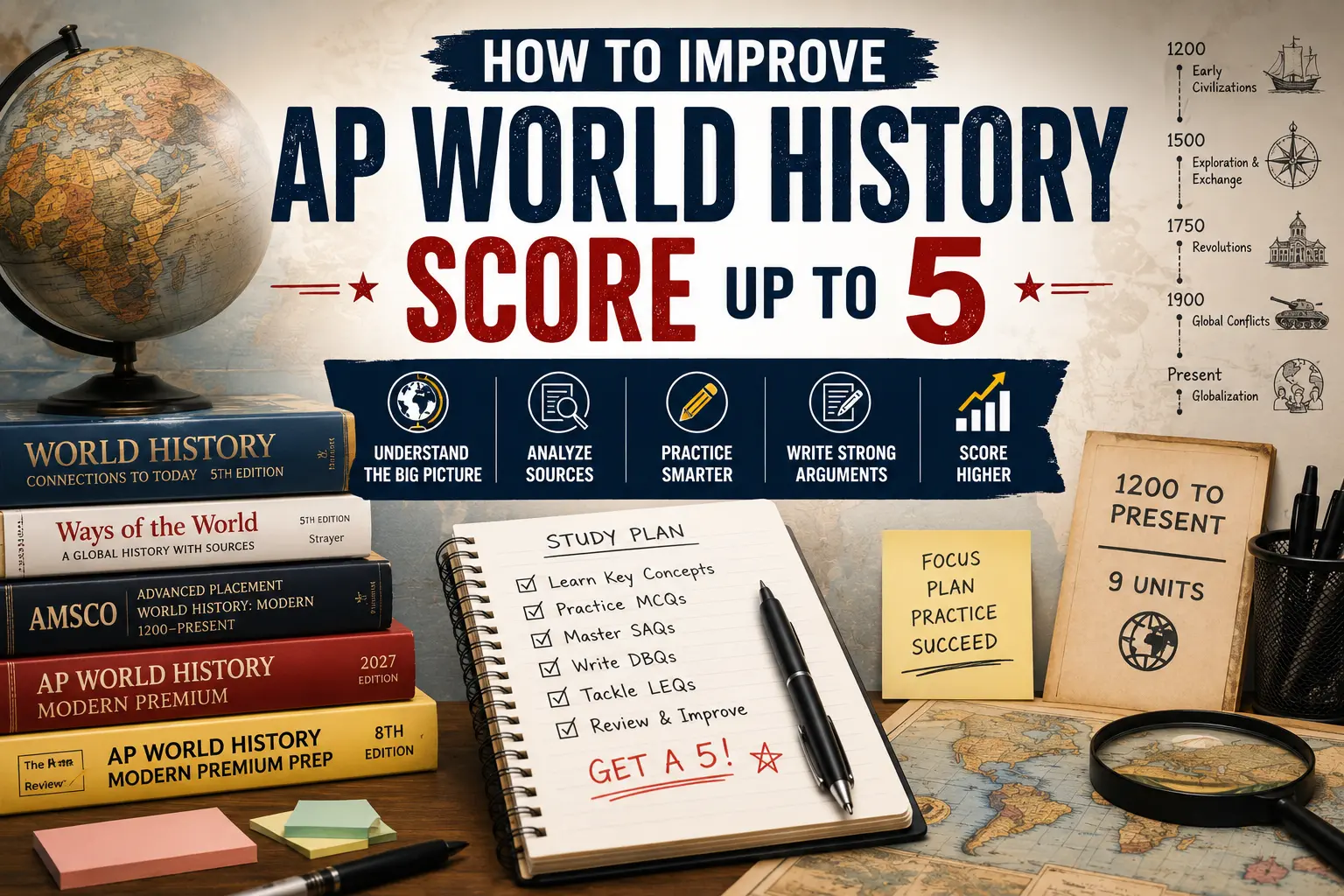
Welcome to AP Exam! If you’re preparing for AP World History: Modern and your goal is to push your AP World History Score all the way to a 5, you’re in the right place.
Let me tell you something before we get into the study plan: you do not need to memorize every person, date, war, treaty, and ruler from 1200 to the present to earn a 5. AP World History is much more about understanding historical processes, making connections between regions and time periods, analyzing sources, and building arguments from evidence.
I’ve approached this guide the way a teacher or experienced AP study guide would approach a student sitting down before an exam: first, we’ll build the right preparation system, then we’ll work on the exam skills that actually convert preparation into points.
I’ll show you which platforms are worth your time, which books can actually help, how to structure your weekly schedule, what high-scoring students do differently, and how to practice so that every study session has a purpose.
The goal isn’t simply to study more.
The goal is to study better.
Table of Contents
First, Understand What You Are Actually Preparing For
Before you create a timetable, you need to understand the AP World History: Modern exam.
The College Board describes the course as an introductory college-level world history course covering developments from approximately 1200 CE to the present. The course is divided into nine units, and the exam tests both historical knowledge and skills such as source analysis, contextualization, comparison, causation, and developing historical arguments.
For the current AP World History: Modern framework, the exam includes multiple-choice questions, short-answer questions, a document-based question, and a long essay question.
| AP World History: Modern Section | Questions | Time | Percentage of Score |
|---|---|---|---|
| Multiple Choice | 55 | 55 minutes | 40% |
| Short Answer | 3 | 40 minutes | 20% |
| Document-Based Question | 1 | 60 minutes | 25% |
| Long Essay Question | 1 | 40 minutes | 15% |
| Total | — | 3 hours 15 minutes | 100% |
The DBQ includes seven documents, while the LEQ asks you to develop and support an argument from a broader historical prompt.
So here’s the first lesson I want you to remember:
Don’t prepare for AP World as if it were only a memorization test.
If you spend three hours reading history but spend zero time practicing source analysis or writing, you’re preparing for only part of the exam.
The Best AP World History Preparation Platforms
You don’t need ten different websites open in your browser.
In fact, constantly jumping between resources can make studying less efficient. Pick a small group of reliable resources and give each one a specific job.
Here are some of the strongest options to consider.
| Platform | Best For | How You Should Use It |
|---|---|---|
| College Board / AP Classroom | Official course material, practice and exam preparation | Use it as your primary reference for exam expectations and official practice |
| Heimler’s History | Concept explanations and review | Use videos when a topic isn’t making sense from your textbook |
| Fiveable | Unit review, key terms and FRQ practice | Use it for targeted review and additional practice |
| Bluebook | Digital exam practice | Use it to become comfortable with the digital testing environment |
The College Board itself provides AP Classroom resources, Bluebook practice, past free-response questions and scoring information. These should be your foundation because they are directly connected to the AP program.
Heimler’s History is particularly useful when you need a concept explained in a more straightforward, student-friendly way. Its AP World History material covers individual units and historical developments and is widely used for review.
Fiveable currently provides AP World History: Modern study guides, practice questions, key terms, FRQ practice and resources covering all nine units. Its current AP World hub is also marked as verified for the 2027 exam.
My recommendation is simple:
College Board = official preparation
Heimler = explanation
Fiveable = additional review and practice
Don’t use three platforms to learn the same chapter three different ways. Use each one for a different purpose.
Best AP World History Books for Preparation
A good prep book can save you a lot of time, but don’t make the mistake of buying five books and finishing none of them.
For the current preparation cycle, these are the titles I’d consider.
| Book | Author | Edition / Year | Best Use |
|---|---|---|---|
| Princeton Review AP World History: Modern Premium Prep | The Princeton Review | 8th Edition, 2026 | Comprehensive review + practice tests |
| AP World History: Modern Premium | John McCannon, Ph.D. | 2027 edition | Detailed review + practice |
| AMSCO Advanced Placement World History: Modern (1200–Present) | AP World History editorial team | Current AMSCO edition | Focused course-aligned content review |
| Ways of the World: A Global History with Sources | Robert W. Strayer | 5th Edition | Deeper textbook-style understanding |
The Princeton Review AP World History: Modern Premium Prep, 8th Edition was published in August 2026 and includes six full-length practice tests, detailed explanations, content review, practice drills and online student tools.
Barron’s AP World History: Modern Premium, 2027 is written by John McCannon, Ph.D., who has taught world history at universities and has worked as an AP Reader for the College Board. The 2027 edition includes five full-length practice tests and is aligned with the updated exam framework.
The AMSCO AP World History: Modern text is another commonly used course resource. The current AMSCO material is organized around the AP World framework and includes the nine course units; Perfection Learning also provides supporting resources for the book.
If you want one practical rule, use one main review book + official College Board practice + one explanation resource.
That is enough for most students.
Which Book Should You Choose?
If you’re asking me, “Teacher, just tell me which one to buy,” here’s how I’d approach it.
Choose Princeton Review if you want a traditional prep book with substantial practice material and a straightforward review structure.
Choose Barron’s if you want detailed content review combined with practice and historical-thinking guidance.
Choose AMSCO if your priority is concise, course-focused review that follows the AP World structure.
Use Ways of the World when you need a deeper textbook-style understanding rather than just a review book.
You don’t need to own all four.
| Your Situation | Best Starting Choice |
|---|---|
| I need a complete review + lots of practice | Princeton Review |
| I need detailed content + practice | Barron’s |
| I want concise AP-focused review | AMSCO |
| I struggle to understand historical developments | Ways of the World |
| I already have a school textbook | Keep it and add one review resource |
And remember: the best AP World book is the one you actually study from.
A perfect book sitting unopened on your desk isn’t going to improve your score.
The Study Method I Recommend for a 5
Now let’s get into the part that matters most.
If you want to move toward a 5, don’t use this cycle:
Read → highlight → read again → forget
Instead, use:
Learn → Recall → Connect → Practice → Review → Repeat
Here’s what that looks like.
First, learn the basic content.
Then close the book.
Try to explain the topic from memory.
Next, connect it to another region, period, or historical process.
Then answer AP-style questions.
Finally, analyze what you got wrong.
This is much more productive than repeatedly rereading the same pages.
For example, suppose you’re studying the Columbian Exchange.
Don’t stop at:
“The Columbian Exchange transferred plants, animals, people and diseases between the Eastern and Western Hemispheres.”
Ask yourself:
- Why did the exchange happen?
- Which regions benefited?
- Which populations suffered?
- How did it affect population growth?
- How did it change labor systems?
- How did it affect global trade?
- What connections can I make to European expansion?
- How did it contribute to the development of Atlantic economies?
Now you’ve turned one topic into a network of historical relationships.
That’s exactly the kind of thinking you want.
What Most Students Miss When Preparing for AP World
This is where I want you to pay close attention.
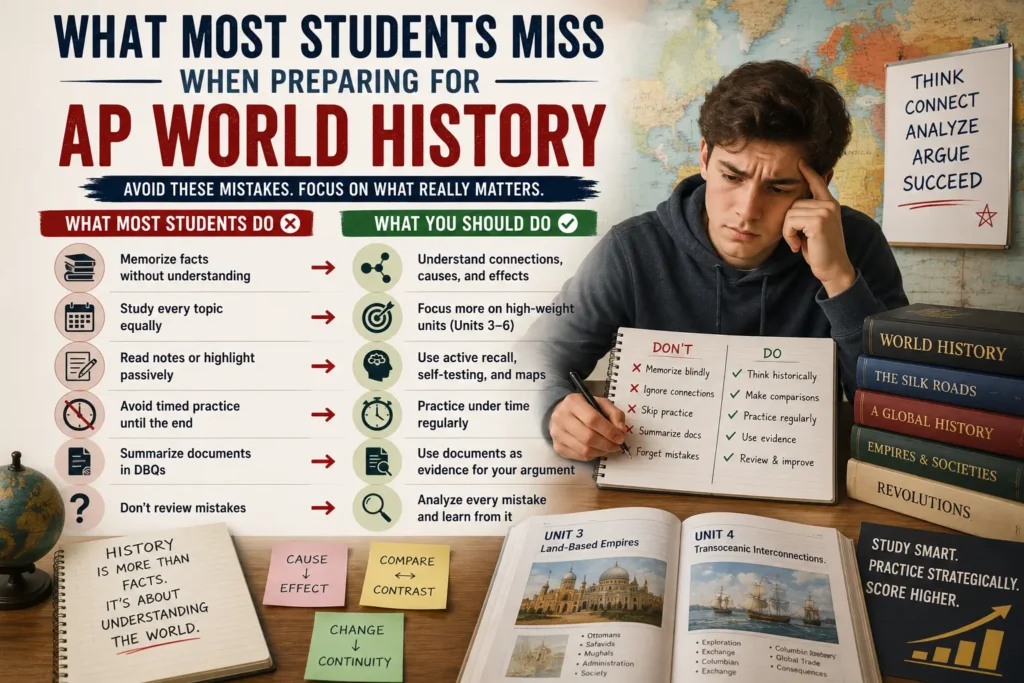
A lot of students work hard but don’t get the AP World History Score they expect because they’re working on the wrong things.
Here are some of the most common problems.
They memorize instead of connecting
They know that the Ottoman, Safavid and Mughal Empires existed, but they can’t compare how those states maintained authority.
They study every topic equally
Not every study session needs to receive the same amount of time.
The College Board assigns approximately 12%–15% of the exam to each of Units 3, 4, 5 and 6, making these particularly important areas to review thoroughly.
They practice questions but don’t analyze mistakes
Getting a question wrong isn’t the real problem.
Getting it wrong and learning nothing from it is.
They avoid writing until the last few weeks
That is a serious mistake.
You don’t want your first real timed DBQ to happen during final exam week.
They know facts but can’t use evidence
AP World rewards historical reasoning, not a random collection of facts.
They don’t practice under time pressure
A student who can answer a question correctly in unlimited time may struggle when the clock is running.
If you’re doing any of these things, don’t panic.
You can change your preparation strategy.
The Best Weekly AP World History Study Schedule
Now let’s make this practical.
If you’re taking AP World alongside your other classes, you probably don’t have five hours every day.
You don’t need that.
A consistent 60–90 minutes on most weekdays, combined with a longer weekend session, can give you a much more sustainable routine.
7-Day AP World Study Schedule
| Day | Study Time | Main Task |
|---|---|---|
| Monday | 60–75 min | Learn/review current unit |
| Tuesday | 60 min | Active recall + key historical connections |
| Wednesday | 60–75 min | MCQ practice + mistake analysis |
| Thursday | 60 min | SAQ or source-analysis practice |
| Friday | 45–60 min | Review weak topics |
| Saturday | 90–120 min | DBQ/LEQ or longer practice session |
| Sunday | 45–60 min | Weekly review + plan next week |
Notice something important.
You’re not spending seven days simply reading chapters.
You’re rotating different skills.
That’s intentional.
The College Board exam itself tests multiple-choice questions, SAQs, DBQs and LEQs, so your study routine should eventually include all of them.
A 12-Week AP World History Schedule
If you have roughly three months before your exam, here’s a practical structure.
| Weeks | Primary Goal | What to Do |
|---|---|---|
| 1–3 | Build content foundation | Units 1–3 + active recall |
| 4–6 | Continue content | Units 4–6 + MCQ practice |
| 7–8 | Finish course review | Units 7–9 + cumulative review |
| 9–10 | Skill development | DBQs, LEQs, SAQs + mixed MCQs |
| 11 | Full review | Weak units + timed practice |
| 12 | Exam simulation | Full practice tests + targeted correction |
Don’t interpret this as a rigid calendar.
If your class is already on Unit 6, you shouldn’t go back to Unit 1 just because the table says so.
Your school schedule and your current level matter.
The important thing is to move from content acquisition toward exam application as the exam gets closer.
The 30-Day AP World History Crash Plan
If you’re much closer to the exam, don’t try to reread an entire textbook from page one.
You need a more aggressive strategy.
Days 1–7: Identify Your Weaknesses
Complete mixed practice.
Record:
- Units you miss
- Question types you miss
- Historical concepts you confuse
- Writing weaknesses
- Timing problems
Days 8–15: Repair Content Gaps
Focus heavily on your weakest units.
Use your main review book and targeted videos.
Don’t spend hours reviewing material you already know.
Days 16–22: Exam Skills
Practice:
- MCQs
- SAQs
- DBQ planning
- Timed DBQ writing
- LEQ planning
- Timed LEQ writing
Days 23–27: Full Practice
Take realistic practice sections under timed conditions.
Days 28–30: Final Correction
Review your mistakes.
Don’t try to learn 500 new facts.
Focus on the concepts you repeatedly forget or misunderstand.
How to Study Each AP World Unit
Here’s another method I strongly recommend.
When you finish a unit, create a one-page historical map.
Put the unit title in the center.
Then organize your notes around:
- Governance
- Economy
- Society
- Culture
- Technology
- Environment
- Trade
- Migration
- Conflict
- Religion
For example, when studying Unit 6, you might connect industrialization to imperialism, migration, labor systems, economic change and resistance.
The goal is to see the relationship between developments.
The College Board specifically emphasizes analyzing sources, placing developments in context, making connections, and supporting historical arguments.
Use Comparison to Make AP World Easier
Comparison is one of your most useful tools because AP World covers multiple regions at the same time.
When studying an empire, don’t study it in isolation.
Compare it.
| Historical Development | Example 1 | Example 2 | What to Compare |
|---|---|---|---|
| Land-Based Empires | Ottoman | Mughal | Administration and legitimacy |
| Trade Networks | Silk Roads | Indian Ocean | Goods, people and cultural exchange |
| Industrialization | Britain | Japan | Causes and state involvement |
| Imperialism | British India | French Indochina | Methods of control |
| Revolution | French Revolution | Haitian Revolution | Causes, participants and outcomes |
Once you start doing this, a huge amount of information begins to organize itself.
You’re no longer memorizing five separate chapters.
You’re learning one historical concept through five examples.
How to Improve Your AP World History Multiple-Choice Score
The multiple-choice section is worth 40% of the total score, so you can’t afford to treat it as an afterthought. (AP Students)
Most AP World multiple-choice questions come in sets connected to a stimulus.
That stimulus might be:
- A written source
- A map
- A chart
- An image
- A political cartoon
- A historical argument
When you see a stimulus, don’t immediately jump to the answer choices.
First ask:
What is this source telling me?
Then consider:
- Who created it?
- When?
- Where?
- Why?
- Who was the audience?
- What historical development does it represent?
- What broader process does it connect to?
Then read the question.
This simple habit can prevent you from choosing an answer that is historically true but doesn’t actually answer the question.
The 3-Step Method for Every Wrong MCQ
Every time you miss a question, write down three things.
1. Why was my answer wrong?
2. Why is the correct answer right?
3. What clue should I have noticed?
For example:
I chose B because I recognized the historical event, but the question asked for the immediate consequence. The correct answer was D because it directly followed the development described in the stimulus.
That is much more useful than writing:
Wrong — correct answer D.
Your mistakes should become study material.
How to Improve Your SAQ Score
The SAQ section is not the place to write beautiful paragraphs.
It’s the place to answer precisely.
For every part of an SAQ, make sure you’re doing exactly what the question asks.
If it asks you to identify, identify.
If it asks you to describe, describe.
If it asks you to explain, explain the relationship.
A useful approach is:
Claim → Specific Evidence → Explanation
Don’t write everything you know about the topic.
Write what answers the prompt.
The current AP World exam includes three required SAQs, and the College Board describes them as testing source analysis, historical context and connections between developments and processes.
How to Improve Your DBQ Score
The DBQ is worth 25% of your AP World History Score, so improving your DBQ technique can have a meaningful effect on your overall performance.
The biggest mistake I see students make with DBQs is this:
They summarize the documents.
Don’t do that.
You’re supposed to use the documents as evidence for an argument.
Think of the process like this:
Prompt → Thesis → Document Groups → Evidence → Explanation → Argument
When reading the documents, ask:
“How can I use this document to prove something?”
That’s much better than:
“What does this document say?”
A Simple DBQ Practice Routine
Don’t write a full DBQ every single day.
Instead:
Week 1
Practice thesis statements.
Week 2
Practice document grouping.
Week 3
Practice contextualization and outside evidence.
Week 4
Write a complete timed DBQ.
Then repeat the cycle with a new topic.
The College Board recommends 60 minutes for the DBQ, including a 15-minute reading period. (AP Students)
As you get closer to the exam, practice under those conditions.
How to Improve Your LEQ Score
The LEQ gives you an opportunity to choose from a set of prompts and build an argument around the historical knowledge you know best.
You don’t need to mention every event you remember.
Choose evidence that directly supports your argument.
Before writing, quickly identify:
- What is the question asking?
- What position can I defend?
- What three or four pieces of evidence do I know?
- How are those pieces of evidence connected?
- What broader historical context can I use?
Then write.
The AP World LEQ is allocated 40 minutes and represents 15% of the exam score.
What Students Aiming for a 5 Do Differently
Let’s be honest.
Getting a 5 isn’t simply about studying longer than everyone else.
You need to make your study time more productive.
Students who are serious about a top score tend to do several things consistently:
- They practice before they feel completely ready.
- They review mistakes instead of hiding from them.
- They connect regions and time periods.
- They practice writing throughout the year.
- They use historical evidence rather than vague statements.
- They study the question format.
- They practice under time limits.
- They revisit weak areas repeatedly.
- They don’t confuse familiarity with mastery.
- They measure progress instead of guessing whether they’re improving.
The last point is especially important.
If you read a chapter and think, “I understand this,” that’s not enough.
Close the book.
Explain it.
Answer questions.
Write an SAQ.
If you can’t do those things, you don’t fully own the material yet.
The “Teach It Back” Method
Here’s one of my favorite study techniques for history.
Study a topic for 20–30 minutes.
Then close everything.
Pretend you’re teaching the topic to another student.
Explain:
- What happened
- Why it happened
- Who was involved
- What changed
- What remained the same
- What other historical development it connects to
If you get stuck, you’ve found a knowledge gap.
Go back.
Fix it.
Try again.
This is far more powerful than highlighting another page.
How to Know Whether Your AP World History Score Is Improving
Don’t judge your preparation based on how confident you feel.
Use actual practice performance.
Keep a simple record after every serious practice session.
| Practice | MCQ Accuracy | SAQ | DBQ/LEQ | Main Weakness | Next Action |
|---|---|---|---|---|---|
| Test 1 | 62% | 2/3 | Weak | Unit 4 | Review Unit 4 |
| Test 2 | 68% | 2/3 | Better | Unit 6 | Practice Unit 6 |
| Test 3 | 74% | 3/3 | Better | Timing | Timed practice |
| Test 4 | 79% | 3/3 | Strong | Minor content gaps | Final review |
Your goal isn’t necessarily to see a perfect score immediately.
You’re looking for a positive trend.
You can also use our AP World History Score Calculator to estimate your performance after practice sessions and see where you currently stand.
Just remember that an online calculator is an estimation tool, not an official College Board score.
How Much Should You Study Every Day?
There isn’t one magic number.
Your ideal study time depends on how far you are from the exam and how strong your current preparation is.
| Preparation Stage | Recommended Daily Study | Main Focus |
|---|---|---|
| Early in the course | 45–60 min | Learn and understand content |
| Middle of the course | 60–90 min | Content + MCQs + writing |
| 6–8 weeks before exam | 90–120 min | Mixed practice + weak areas |
| Final 2–4 weeks | 90–150 min | Timed practice + correction |
| Final few days | 45–90 min | Light review and confidence building |
These aren’t strict requirements.
If you’re already performing strongly, you may need less.
If you’re struggling with several units, you may need more targeted practice.
What matters most is quality and consistency.
A Final 7-Day Strategy Before the Exam
When you’re one week away, don’t suddenly attempt to relearn the entire course.
Your job now is to sharpen your existing knowledge.
7 Days Before
Take a full practice exam or a realistic combination of timed sections.
6 Days Before
Review every mistake.
5 Days Before
Focus on your weakest two units.
4 Days Before
Practice DBQ and LEQ skills.
3 Days Before
Do mixed MCQs and SAQs.
2 Days Before
Review major themes, comparisons and historical connections.
1 Day Before
Keep the review light.
Get your materials ready.
Sleep properly.
Don’t spend the night trying to memorize an entire textbook.
Final Thoughts: Your Road to an AP World History Score of 5
If you remember only one thing from this guide, remember this:
Don’t study AP World History as a list of facts. Study it as a series of connected historical processes.
When you learn about an empire, compare it with another empire.
When you learn about a revolution, ask what caused it and what changed afterward.
When you study a trade network, ask how it affected economies, cultures, environments and societies.
When you read a document, ask what the author is trying to show you.
When you miss a question, don’t simply look at the correct answer.
Ask why you missed it.
And when you write an essay, don’t try to prove that you know everything.
Use the evidence you know to prove your argument.
That’s the difference between studying history and preparing for AP World History.
Your preparation can follow a simple cycle:
Learn the content → recall it without notes → connect it to other developments → practice AP-style questions → analyze mistakes → repeat.
If you follow that process consistently, you’re not just increasing the amount of information you know. You’re building the exact habits that the AP World History: Modern exam asks you to demonstrate.
And when your practice results begin improving, track that progress. Use your AP World History Score Calculator to turn your practice performance into an estimated score and identify whether your preparation is moving in the right direction.
A score of 5 shouldn’t be treated as something you simply hope for on exam day.
Build the knowledge. Build the skills. Practice under pressure. Fix your weaknesses. Then walk into the exam knowing exactly what you’re capable of.
You can also check How to Improve AP US History Score in AP Exam: A Best Practical Study Guide to Get 5
Frequently Asked Questions About AP World History Score
How can I improve my AP World History Score?
Start by identifying exactly where you’re losing points. Combine content review with MCQ practice, SAQs, DBQs, LEQs and mistake analysis. Your goal should be to improve both historical knowledge and the skills needed to apply that knowledge.
How can I get a 5 on AP World History?
A 5 requires more than memorization. Build strong content knowledge, understand historical connections, practice source analysis, develop strong written arguments, complete timed practice and repeatedly review your mistakes.
What is the best way to study AP World History?
Use a combination of active recall, historical comparison, cause-and-effect analysis, source practice, AP-style questions and timed writing. Avoid relying entirely on passive rereading.
How many hours should I study for AP World History?
There is no universal number of hours that guarantees a 5. A consistent 60–90 minutes on most study days can be productive during the course, while students often increase targeted practice as the exam approaches.
What are the best books for AP World History?
Strong options include Princeton Review AP World History: Modern Premium Prep, Barron’s AP World History: Modern Premium, AMSCO’s Advanced Placement World History: Modern, and Ways of the World: A Global History with Sources. Choose based on whether you need concise review, detailed content, practice tests or deeper textbook-style understanding.
Is AMSCO good for AP World History?
AMSCO is designed specifically around the AP World History: Modern course framework and is used as a supplemental resource in many AP World programs. It can be especially useful when you want focused content review rather than a general world-history textbook.
Is Heimler’s History good for AP World?
Heimler’s History can be useful when you need a difficult historical concept explained in a more accessible way. It works particularly well as a supplement to your main textbook or review book rather than as your only preparation resource.
Should I memorize every date for AP World History?
No. You should understand the chronology of major developments, but the exam also requires you to analyze sources, make historical connections and develop arguments. Understanding why developments happened and what consequences they produced is more useful than memorizing isolated dates.
How important is the DBQ for my AP World History Score?
The DBQ is worth 25% of the AP World History exam score, so it is a major part of your overall performance.
How can I improve my AP World History multiple-choice score?
Practice with stimulus-based questions, analyze the historical context of each source and carefully read what the question is asking. After every practice session, review incorrect answers and identify the reason you missed them.
Can an AP World History Score Calculator predict my official score?
No. A calculator can provide an estimated score based on your practice performance, but your official AP score is determined through the College Board’s scoring process.